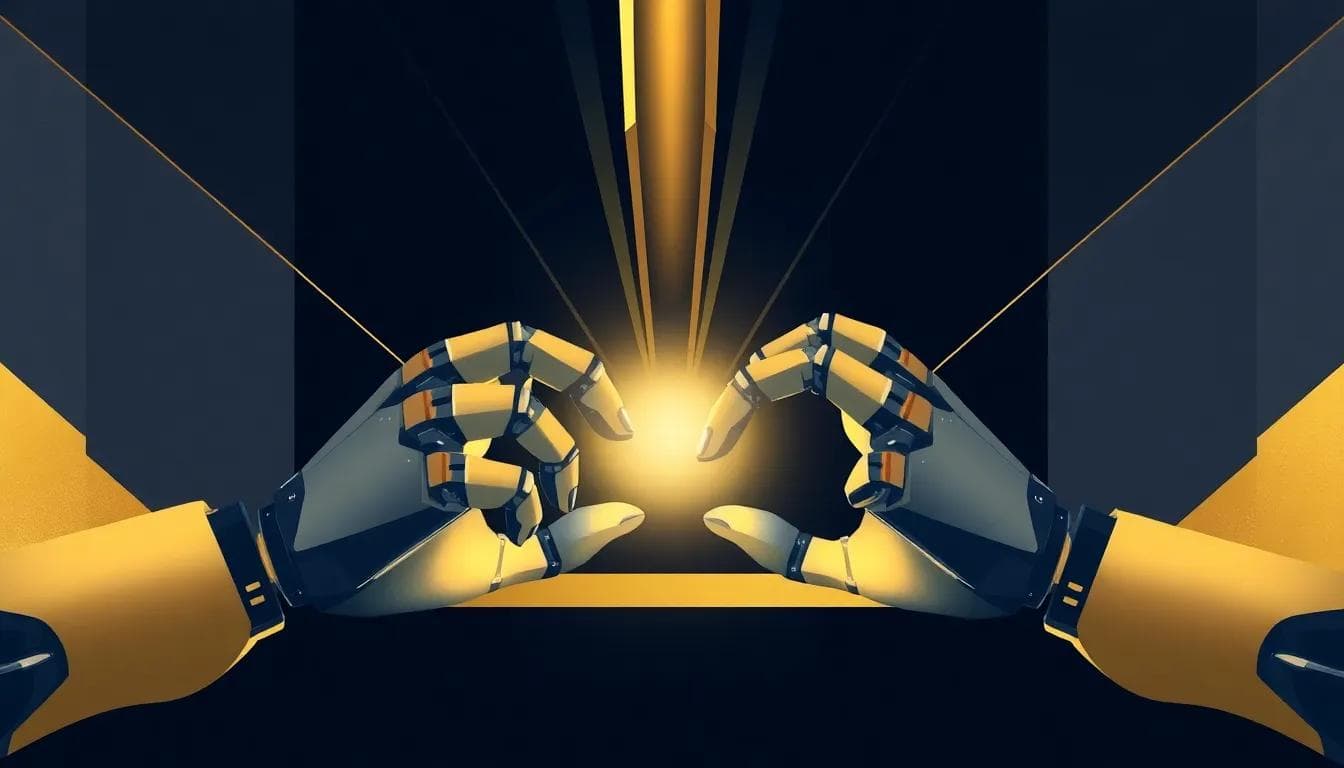
Genesis AI's $105M Gamble: Why Robotic Hands Beat Robot Brains

Genesis AI just flipped the robotics playbook upside down. While every startup chases the perfect AI model, this Khosla-backed company spent $105 million to build something radically different: robotic hands that actually look and move like yours.
Their debut model GENE-26.5 isn't the real story here. The real breakthrough is those eerily human-like appendages performing complex manipulation tasks that would make Boston Dynamics jealous.
<> "The model has always been the goal, because a better model means better intelligence... So we decided to go full stack." - CEO Zhou Xian/>
But here's what Zhou isn't saying out loud: data is everything, and most robots are data-starved.
The Gripper Problem Nobody Talks About
Most robotics companies slap two-finger grippers on their bots and call it progress. It's like teaching a pianist to play Chopin while wearing oven mitts.
Genesis cracked the code differently. Their human-scale hands don't just look like ours—they generate exponentially more training data. President Gervet, who jumped ship from Mistral AI, puts it bluntly: human-like hands enable "a lot more data" collection for training models on diverse tasks.
Think about it. Every YouTube video, every instructional demo, every human manipulation task ever recorded becomes potential training material. That's internet-scale embodied data that two-finger grippers simply can't access.
The 43 Million FPS Advantage
Genesis isn't just building better hardware—they're rewriting the physics of robotics development. Their open-source Genesis simulation platform runs at a mind-bending 43 million frames per second. That's 430,000x real-time speed.
While competitors wait weeks for training cycles, Genesis iterates in hours. Their proprietary simulation addresses the evaluation bottleneck that's been choking robotics AI for years.
The technical specs are staggering:
- GPU-accelerated physics engine rebuilt from scratch
- Unified solvers with optimized collision checking
- Generative data engine powered by VLM-based agents
- Auto-hibernation and contact islands for efficiency
The Real Story
Here's what the TechCrunch demo doesn't reveal: Genesis AI is playing a completely different game than Figure AI, 1X Technologies, or Tesla's Optimus team.
They're not trying to build the smartest robot. They're building the fastest learning robot. And speed trumps sophistication every time in AI.
Consider the math:
1. Human-like hands unlock human-scale datasets
2. 43M FPS simulation creates unlimited training scenarios
3. Open-source ecosystem builds developer lock-in
4. Full-stack control eliminates sim-to-real gaps
That's not just vertical integration—that's data moat construction.
Why Khosla Bet Big
Vinod Khosla didn't write a $105 million seed check for pretty hands. He spotted the same pattern that made OpenAI unstoppable: whoever controls the data flywheel wins the category.
Genesis positioned themselves as the "global physical AI lab" with a universal robotics foundation model. Translation: they want to be the GPT of physical intelligence.
The warehouse automation market alone is projected to hit $40+ billion by 2030. But Genesis isn't thinking warehouses—they're thinking everywhere.
<> "unlimited physical labor" to free humans for creative work/>
That's not startup hyperbole. That's a $10 trillion market thesis.
The bottom line? While everyone else builds robot bodies, Genesis AI built robot metabolism. Their hands don't just manipulate objects—they metabolize human knowledge at superhuman speed.
Robotics just got its iPhone moment. And most people are still building flip phones.