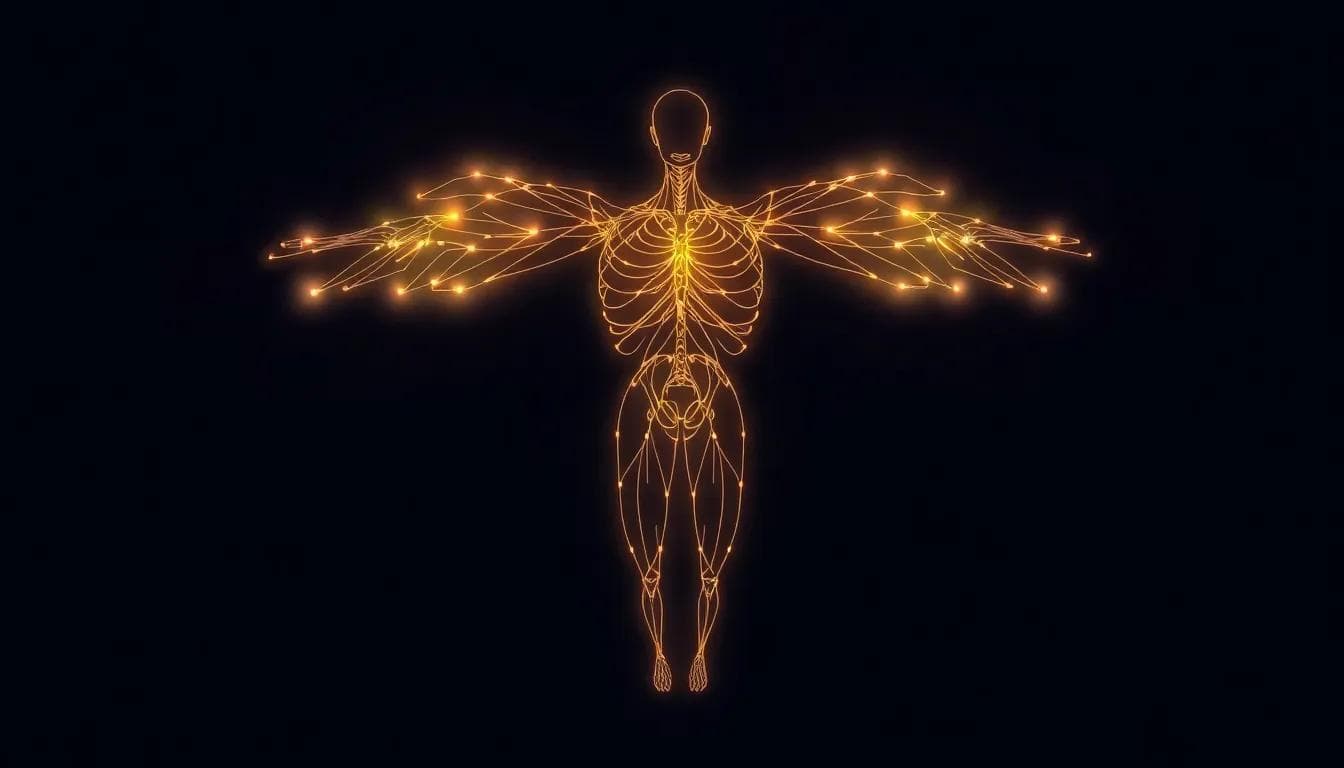
Georgia Witchel's Physics Engine Creates Digital Humans That Predict Your Achilles Injury

Georgia Witchel can predict when an NFL player will tear their Achilles tendon. Using motion capture, training logs, diet data, and performance metrics, her startup Mantis Biotech creates digital twins that simulate human anatomy with physics-based precision.
This isn't your typical AI health startup throwing neural networks at medical data and hoping for the best.
Witchel, a former elite ice climber who built the U.S. ice climbing team, brings a unique perspective to biomedical modeling. With degrees spanning CS, psychology, computational math, and biomedical engineering, she's tackling medicine's fundamental data problem: we just don't have enough good data to build reliable predictive models.
<> "We're able to take all these disparate data sources and then turn them into predictive models for how people are going to perform."/>
The approach is brilliantly simple. Mantis takes textbooks, motion capture cameras, biometric sensors, training logs, and medical imaging, then runs it through an LLM-based routing and validation system. But here's the kicker - instead of stopping at synthetic data generation like everyone else, they feed everything into a physics engine that produces high-fidelity renders for training predictive models.
Physics matters here. A lot.
Pure generative AI can hallucinate plausible-sounding medical data that's completely wrong. But physics engines ground the synthetic data in reality - bones can only bend so far, muscles have actual force limits, cardiovascular systems follow thermodynamic laws.
What Nobody Is Talking About
This isn't Witchel's first rodeo with physics-based medical simulations. Before Mantis, she founded Louiza Labs, which built physics engines for autonomous robotic surgery and simulated FDA trials. Think about that for a second - running regulatory approval simulations before touching a single human patient.
The FDA angle is huge. Clinical trials fail 80% of the time due to data inaccuracies from manual entry and inconsistent practices. Each failure costs an average of $15 million. If Mantis can catch problems in simulation first, the cost savings are staggering.
Launched through Y Combinator's Winter 2026 batch, Mantis initially pitched as "Databricks for Biomedical and Clinical Data." Smart positioning. Every developer knows Databricks - it's the gold standard for data lakehouse architecture. Promising the same unified analytics experience for medical data immediately communicates the value prop.
But I think they're underselling themselves.
The real magic happens in the physics layer. While competitors focus on cleaning and organizing existing medical data, Mantis is manufacturing new datasets that capture edge cases and rare behaviors impossible to collect from real patients.
Want to study how a specific genetic variant affects muscle recovery under extreme training loads? Good luck recruiting enough subjects for statistical significance. Want to test surgical approaches on patients with rare anatomical variations? Ethically problematic and practically impossible.
Digital twins solve both problems elegantly.
The technical implementation is particularly clever:
1. LLM routing identifies relevant data sources across disparate systems
2. Validation layer ensures data quality and consistency
3. Physics synthesis converts clean data into anatomically accurate simulations
4. Predictive modeling trains on high-fidelity synthetic datasets
For developers, this opens fascinating possibilities. Instead of scraping together tiny datasets for medical ML projects, you could generate massive synthetic datasets grounded in physics. The lineage tracking means you can trace predictions back through the entire data pipeline - crucial for regulatory compliance.
The Reality Check
Digital twins face real challenges. Computing costs are astronomical. Physiological modeling is "a lot more complex than people had thought," according to industry experts. Full patient twins remain years away despite the hype.
But Mantis isn't promising full patient simulation tomorrow. They're starting with specific, tractable problems - predicting sports injuries, optimizing surgical approaches, accelerating clinical trials.
Smart strategy. Build the physics foundation now, expand the scope later.
With only 3 team members and Gustaf Alstromer as their primary Y Combinator partner, Mantis is still tiny. But sometimes the most interesting innovations come from small teams willing to tackle fundamentally hard problems with novel approaches.
Physics-based human simulation feels like one of those ideas that's obvious in retrospect but required someone with Witchel's unique background to actually build.