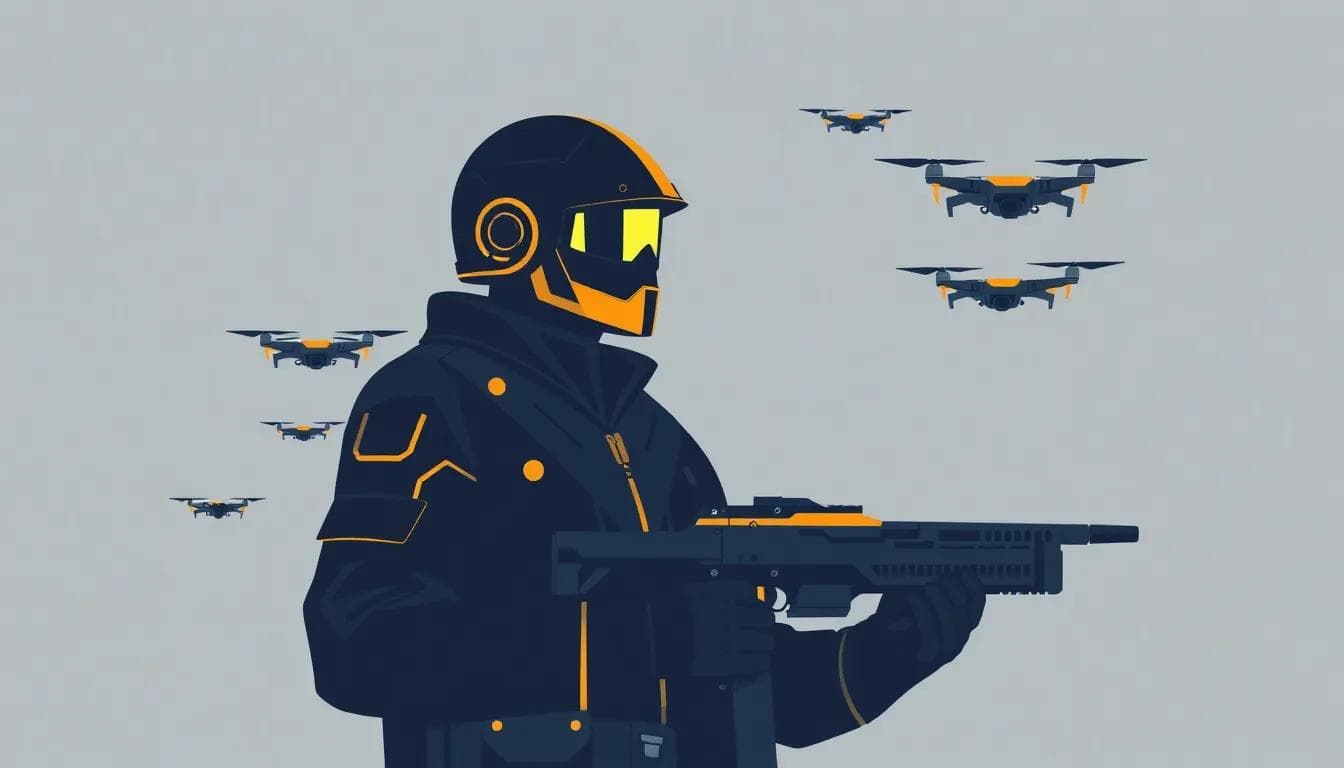
Scout AI's $100M War Machine Lets One Soldier Control Drone Armies

What if commanding a fleet of military drones was as simple as typing "secure that building and watch for hostiles"?
That reality just got $100 million closer. Scout AI's oversubscribed Series A—the largest defense-tech raise in US history—is funding something that sounds ripped from a sci-fi thriller: Fury, a vision-language-action foundation model that lets individual soldiers control swarms of autonomous vehicles through natural language commands.
I'm fascinated by this pivot from Silicon Valley's typical "move fast and break things" to "move fast and break enemy formations." Colby Adcock and Collin Otis founded Scout AI in 2024, and they're not messing around with prototypes. They're training their models at actual US military bases.
<> "This is a signal to every patriot in Silicon Valley," Adcock declared about the massive raise, co-led by Align Ventures and Draper Associates./>
The technical architecture here is genuinely impressive. Fury combines vision, language, and action processing for edge-based reasoning—no cloud dependency when you're in a combat zone. Their first product, Ox, bundles hardened GPUs, communications gear, and cameras into command-and-control software that can orchestrate heterogeneous systems across air, land, sea, and space domains.
This isn't vaporware. The US Army's 1st Cavalry Division at Fort Hood is already using Ox for training exercises. Scout is one of just 20 autonomy companies integrated into their training cycle, with potential deployment by 2027.
The numbers tell a compelling story:
- $100M Series A (April 2026)
- $15M seed round (January 2025)
- $11M in DoD contracts from DARPA and Army Applications Laboratory
- Real deployment with active military units
What excites me most is the foundation model approach to military autonomy. Instead of building point solutions for specific vehicles, Scout is creating an "intelligence layer" that can adapt to existing hardware. Think of it as the ChatGPT moment for unmanned warfare—one model that generalizes across different platforms and missions.
<> Collin Otis claims Fury "finally delivers" the one-to-many autonomy that's been promised for years but never materialized./>
The implications for developers are massive. We're seeing a shift from:
- Siloed autonomy systems → Unified foundation models
- Hardware-first approaches → Software intelligence layers
- Simulation-trained models → Real-world military data training
Scout's "bootcamp" approach—literally training AI at military bases—creates proprietary datasets that competitors can't replicate. That's a genuine moat in an industry where data advantages compound.
Hot Take: The Defense-Tech Gold Rush Is Just Beginning
This $100M raise isn't just about Scout—it's a watershed moment for Silicon Valley's relationship with defense spending. When VCs are writing nine-figure checks for military AI, we're witnessing a fundamental shift in startup priorities.
The controversial part? I think this is necessary. While everyone debates AI safety in chatbots, adversaries are building autonomous weapons systems. Scout's approach—patriotic technologists building defensive capabilities—feels more responsible than pretending the problem doesn't exist.
The real test comes in 2027 deployment. If Scout delivers on their promises, expect a flood of talent and capital into defense tech. The next unicorn might not be in consumer social—it might be in keeping democracies safe.
One soldier commanding drone swarms through natural language. The future of warfare just got a $100M head start.