The 1,500% SaaS Price Shock: Why Custom Invoicing at £35/mo Beats Rental Traps

When BBC News reported this week that customers of popular time-tracking and invoicing tool Harvest were hit with overnight price increases of up to 1,500%, the collective groan across the SME and agency landscape was deafening.
Richard Haldenby, managing director of UK consultancy Salentis, watched his monthly bill escalate from $130 (£95.50) to $2,110 (£1,650+). For a firm of 15 people that had loyally used the platform for 15 years, accepting the increase would double their entire annual IT budget. In the US, other companies reported annual charges rocketing from $2,800 to over $23,000.
This is not an isolated incident. It is the predictable playbook of modern software acquisition, and it exposes an uncomfortable truth every business leader must face: when you rent your mission-critical workflow from a multi-tenant SaaS vendor, you are not a customer. You are an asset being squeezed for yield.
The Playbook: How SaaS Turned Into Rent Extraction
Harvest was acquired in 2025 by Bending Spoons, an Italian tech conglomerate with a well-documented history of acquiring sticky digital tools—including Evernote, WeTransfer, and Vimeo—followed by sharp price hikes, aggressive feature gating, and workforce reductions.
What changed in Harvest's billing architecture is particularly telling:
- From predictable per-seat pricing to usage taxation: Instead of a transparent flat fee per team member, businesses are now charged based on active projects, client counts, task volume, and a percentage cut of the gross revenue invoiced through the platform.
- The "Success Tax": When a billing provider charges you more simply because you invoiced more money or took on more clients, they are no longer charging for computational cost—they are taxing your growth.
- Opaque billing by design: As pricing strategist Mark Peacock noted to the BBC, customers can no longer calculate their upcoming bill until the invoice lands at the end of the month.
- The hostage discount: When customers protest, vendors offer short-term discounts (e.g., $1,309 upfront for the year) to lock them in for another 12 months, delaying the inevitable while switching costs keep compounding.
Why Vendor Lock-In Keeps You Paralyzed
Why don't businesses simply cancel their subscription on day one?
Because invoicing and billing software sits at the very heart of company operations. After 10 to 15 years on a platform, you have:
- Thousands of client records, payment terms, and custom VAT/tax rates.
- Hundreds of thousands of historical billable hours tied to projects.
- Integrations with payment gateways, bank feeds, and accounting ledgers.
- Established team routines and client-facing payment links.
Migrating to another generic SaaS tool usually takes weeks of data export, schema mapping, and retraining—only to face the exact same acquisition and price hike risk two years down the road with the next vendor.
The Real Math: SaaS Subscription vs. Custom Invoicing Infrastructure
For years, the conventional wisdom was: "Never build custom software if you can buy off-the-shelf SaaS."
In the era of modern full-stack frameworks, battle-tested payment APIs like Stripe, and serverless/managed cloud primitives, that equation has completely flipped.
Let's look at the actual 3-year Total Cost of Ownership (TCO) for a 15–25 person consultancy or digital agency:
| Cost Component | Multi-Tenant SaaS (Harvest / New Tiers) | Dedicated Custom Invoicing System |
|---|---|---|
| **Initial Implementation** | £0 (Setup time internal) | £4,000 – £7,500 (One-off build) |
| **Year 1 Running Cost** | £19,800 ($2,110/mo average) | £420 (£35/mo cloud infrastructure) |
| **Year 2 Running Cost** | £21,780 (+10% SaaS price inflation) | £420 (£35/mo cloud infrastructure) |
| **Year 3 Running Cost** | £23,950 (+10% SaaS price inflation) | £420 (£35/mo cloud infrastructure) |
| **Per-User / Per-Client Limits** | Strict tier caps and overages | **Unlimited** (Zero per-seat costs) |
| **Data Ownership & Privacy** | Stored on 3rd-party US/EU servers | **100% owned & isolated database** |
| **Total 3-Year Spend** | **£65,530** | **£5,260 – £8,760** |
| **Net 3-Year Savings** | — | **£56,770 – £60,270** |
Building a custom system is not a speculative expense—it is a high-yield capital investment that achieves full breakeven within 3 to 5 months.
What Does a Modern Independent Invoicing Stack Look Like?
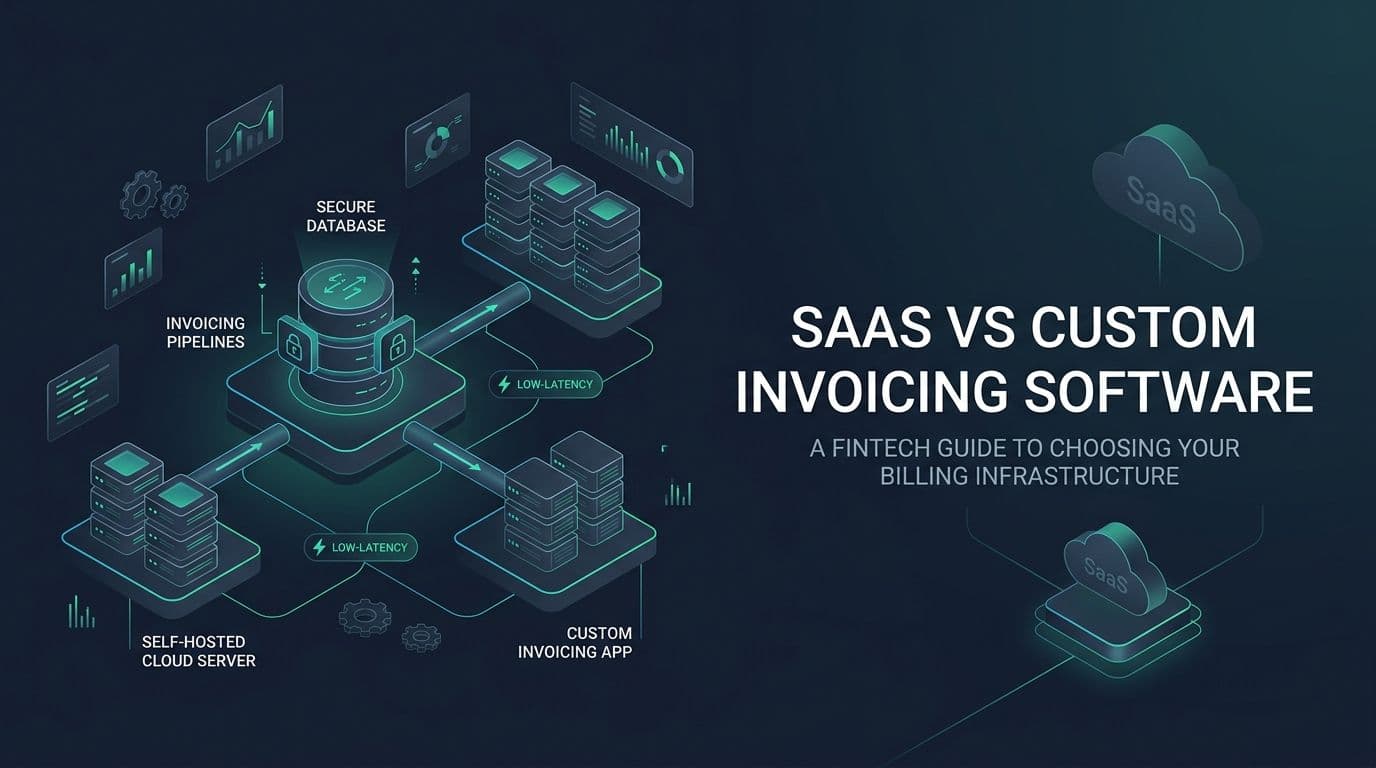
A modern custom billing system does not require months of bloated enterprise development. Built on standard modern web engineering, it delivers maximum performance and complete isolation:
- Engine: Next.js (App Router) + TypeScript for ultra-fast, server-rendered dashboards and client-facing invoice views.
- Database & ORM: PostgreSQL or MySQL with Prisma ORM, providing rigid data schemas, audit trails, and instantaneous reporting.
- Direct Payment Gateway: Native Stripe Checkout & Payment Intents API. Payments go directly from your client to your merchant account with zero intermediary platform fees.
- Dynamic Document Generation: Instant, pixel-perfect PDF rendering (using React-PDF or server-side headless Chromium) with fully branded templates, custom line items, and automated tax calculations (UK VAT, Reverse Charge, US Sales Tax).
- Security & Webhooks: Cryptographically signed share links (
/invoice/INV-2026-XXXX), automated Stripe webhook listeners for instant payment reconciliation, and granular role-based access control.
1// Example: Deterministic, immutable invoice generation model
2export interface Invoice {
3  id: string;
4  invoiceNumber: `INV-${string}`;
5  customerId: string;
6  currency: 'gbp' | 'usd' | 'eur';
7  items: Array<{
8 description: string;Because this architecture runs on lightweight Node.js containers or serverless edge infrastructure, a standard £30–£40/month virtual private server (or managed cloud database + CDN) can comfortably process tens of thousands of invoices per hour with sub-second response times.
How to Break Free: The 4-Step Migration Blueprint
If your business is currently staring down an unaffordable renewal notice, you do not have to settle for another restrictive SaaS platform. Here is how we execute smooth, zero-downtime migrations:
- Automated Data Extraction: We extract your entire historical dataset—clients, rate cards, historical invoices, and time logs—via the legacy vendor's REST API or bulk CSV export.
- Schema Normalization & Ingestion: The data is sanitized, validated, and loaded into your private, dedicated PostgreSQL/MySQL database instance.
- Workflow Customization: We configure your exact billing cycles, approval hierarchies, currency matrices, and email delivery templates.
- Cutover & DNS Routing: We connect your custom domain (
billing.yourcompany.com), connect your Stripe credentials, and decommission the legacy SaaS subscription.
The Bottom Line: Own Your Tools, Don't Rent Your Core
The era of cheap, benevolent SaaS is coming to a close. As venture capital and private equity rollups consolidate mature business applications, price shocks like Harvest's 1,500% increase will become the rule rather than the exception.
Your billing, invoicing, and client relationship data are the lifeblood of your company. Renting them on unpredictable terms is a strategic risk you no longer need to take.
By moving to a tailored, self-hosted system, you regain control over your financial infrastructure, protect your cash flow, and ensure that your software bill never doubles overnight again.
Ready to evaluate your options? Get in touch to schedule a software architecture audit and receive a fixed-price estimate for custom billing development.