Yes, "Programmer" Is Still a Profession. No, That Isn't Good News.

Last week I opened the website of a tailoring and alterations shop. Small business, one location, the kind of place that hems trousers and takes in wedding dresses.
The site was built in that instantly recognisable 2026 house style: sand and beige palette, Tailwind everywhere, sections that bounce gently as you scroll, small shimmering dots drifting in the background. You can spot it from across the room. Somebody had spent real money on tokens.
Then I did what a developer does and opened the bundle.
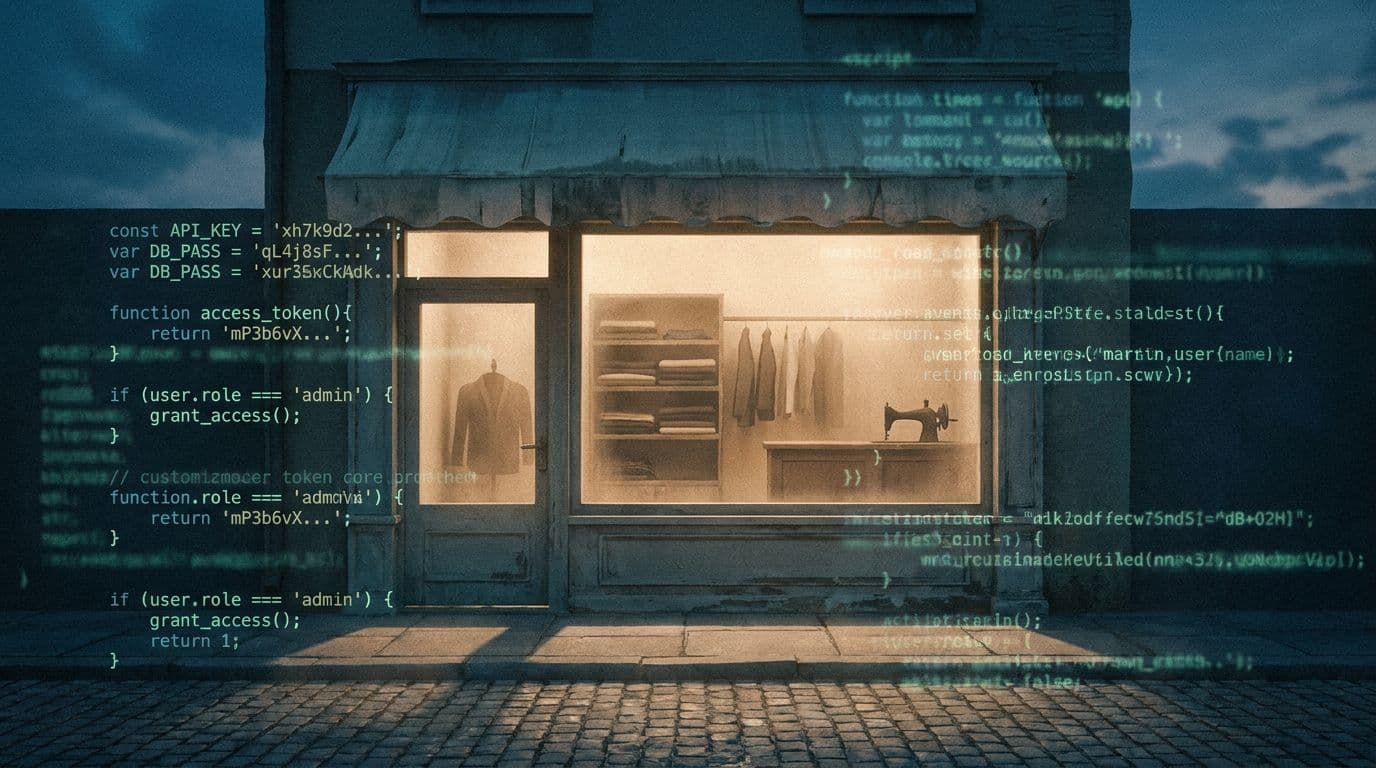
I am hard to surprise. This one managed it. Compiled by the book — Node, Vite, a modern framework, all the ceremony — and sitting inside it, in plain readable text, was the shop's entire security model:
1// shipped to every visitor, in the production bundle
2const ADMIN_PASSWORD = "atelier2026";
3
4export function login(password) {
5  if (password === ADMIN_PASSWORD) {
6    localStorage.setItem("role", "admin");   // the only access control there is
7    return true;
8 }To become the administrator of that business you do not need the password. You need the developer console and one line: localStorage.setItem("role","admin"). The password is decorative. The Telegram token was live. I have changed the identifying details; I have not changed the shape.
It Is Not an Unlucky Find
I would love to file this under bad luck. The measurements say otherwise.
- Escape scanned over 1,400 vibe-coded production applications and found 65% with security issues and 58% carrying at least one critical vulnerability — including 400+ exposed secrets and 175 instances of exposed personal data.
- GitGuardian's State of Secrets Sprawl 2026 counted 28.65 million new hardcoded secrets in public GitHub commits during 2025 — a 34% jump year over year, the largest ever recorded. AI-assisted commits leaked secrets at 3.2%, against a 1.5% baseline. Roughly double.
- CVE-2025-48757: a researcher scanned 1,645 projects from Lovable's own public showcase and found 170 with missing or inadequate row-level security, exposing 303 endpoints that leaked names, emails, phone numbers, home addresses, payment information and third-party API keys. The public anon key shipped in the client did the rest.
The Model Did Exactly What It Was Told
I can reconstruct almost exactly how that shop got its website. Someone typed something close to: "I don't know what a backend even is, just make it all work." And the agent obeyed. Completely. Competently.
That is the part worth being precise about, because it is where most of this argument goes wrong. The model did not fail. It succeeded at the task it was given. Nobody in that conversation knew that "make it work" and "make it safe to put on the internet" are two different requests, so only one of them was ever made — and these systems answer the request in front of them, not the one you should have written.
The useful way to think about them is as a flawless translator into a language you cannot read. Whatever you say is rendered faithfully and at speed, including the parts of your request you did not know you were making. And you cannot proofread the result. The bundle is right there, public, served to every visitor — and the person who paid for it will never open it, because to them it is not text.
I Am Not Saying This From the Outside
I have been with generative AI since it appeared, and I cheated a little to get there. When ChatGPT launched at the end of November 2022 I was still in Ukraine, and Ukraine was not on the supported-countries list — not because of the war as such, but because of US sanctions law and OpenAI's inability at the time to geofence occupied Crimea separately from the rest of the country. So I asked my aunt, who lives in Britain, to confirm the sign-up SMS with her number. The restriction was lifted later. For that first stretch, a borrowed phone number was my entire access to the future.
The timing has never fully settled for me. Late 2022: on one side of the ledger, humanity ships a genuine breakthrough in artificial intelligence — and that deserves capitals, ARTIFICIAL INTELLIGENCE. On the other, in the middle of Europe, a war is underway that is simply impossible from the point of view of civilisation. Put both on a number line and they land at minus infinity and plus infinity. I stopped trying to reconcile them.
Then the euphoria wore off and the rawness showed, especially around code. GPT-3.5 shipped with a context window of roughly 4,000 tokens. You could paste in a controller and a model, and by the time you added the migration it had forgotten the controller. There was no Claude Code, no Codex CLI, no Antigravity — not as products, not as ideas. All of that was three years out.
My first genuinely impressive coding results came with GitHub Copilot — and here I have to correct my own memory, because Copilot did not follow ChatGPT, it preceded it: technical preview in June 2021, general availability in June 2022. Then Anthropic's models started doing something different in kind. The code coming out of them began to respect SOLID, DRY and sane boundaries — not because you asked for a pattern, but by default.
So let me be clear about where I stand before I criticise anything: the tools are extraordinary, and I use them every working day. This is the best moment in history to test an idea for the price of a subscription, and you should go and do it. My complaint has never been that the machines are bad.
The Part Where I Argue Against Myself
Here is where essays like this one usually cheat, so let me not.
The serious version of the pessimist case was never "AI will replace developers." It is narrower and much harder to answer: AI compresses how many people you need per unit of shipped product. A team that needed six now ships with three. That is not a forecast, it is a purchase order, and it is being signed right now. No amount of arguing about craft refills those three seats.
And it lands unevenly. The work that got automated first is precisely the junior ladder — the small tickets you used to hand a graduate so they would learn the codebase by fixing something harmless. Remove those rungs and you have not only cut this year's hiring, you have mortgaged the supply of seniors ten years out. I do not have a good answer to that, and neither does anyone else I have heard on the subject.
The market reflects it. Indeed's Hiring Lab has UK job postings down 11% through the first half of 2026 and 32% below their pre-pandemic baseline. CV-Library puts Software Engineer at the top of the UK's most-applied-for roles — more applications per vacancy than any other job in the country. Fewer doors, more hands.
AI is not even the whole story. Investors think four times before parting with liquidity during a period of global instability. And the worldwide factories for stamping out IT specialists — the two-month bootcamps promising graduates they would "easily land $500+ a month" — did not saturate this market, they oversaturated it, and they did it before ChatGPT existed. QA has looked like this for a decade. Four hundred CVs for one QA opening was not a joke in 2018 either.
What I can add is what lands in the inbox. On roles opened by companies I work with, I have watched one engineering vacancy pull roughly three hundred applications. That is my own count rather than a published figure — but the composition is the part that matters. It was not three hundred spam submissions filed to satisfy a Universal Credit job-search log. Well over two hundred were relevant, and somewhere between seventy and a hundred were excellent: five-plus years commercial, vendor certifications, real delivery history. With families. With mortgages. Released in whole departments at once, because demand dipped, or because of a reorganisation, an optimisation, or some other word ending in -ation.
So I am not going to tell those people the market is fine. It is not.
The Profession Is Not the Job Market
But those are two different claims, and treating them as one is what makes both sides of this argument stupid.
"Fewer people will be paid to write code" and "knowing how to build software no longer matters" do not follow from one another. What collapsed in price is the production of code, which is now very nearly free. What did not collapse — what actually became scarcer relative to demand — is the ability to look at what came out and know what is wrong with it.
The tailor shop is the proof, and there are going to be hundreds of thousands of tailor shops. Every one of those bundles is work: not glamorous work, not a FAANG offer, but somebody has to be the person who opens it, finds the admin string, and knows what row-level security is for. The volume of software being produced by people who cannot evaluate it is going vertical. That is not a shrinking market for competence. It is the largest backlog of remedial engineering in the history of the field.
I should say plainly where I am standing while I write this: I run a software company. "Hire a professional" is a sentence with my invoice attached to it, and you should discount it accordingly. Then notice that the argument does not actually depend on my being disinterested. It depends on whether the bundle is public — and you can check that yourself, on any site you like, in about thirty seconds.
So: build your prototype with whatever agent you like. Genuinely, go and do it. But when it starts working — when real customers with real names and real card details begin arriving — understand that you have crossed from a demo into a system holding other people's data, and that the crossing happened silently. No prompt. No warning. Nobody in the loop who could read the output.
The bundle is public. Everything you put in it is public too. That has been true since the first web page, and no amount of intelligence, artificial or otherwise, is going to repeal it.