TailwindCSS Lays Off 75% of Team as AI Crushes Documentation-Based Revenue Model

In a stunning revelation that sent shockwaves through the open-source community, Adam Wathan, creator of TailwindCSS, announced that 75% of the Tailwind Labs engineering team was laid off — not because the framework is failing, but precisely because it's too successful for AI to ignore.
The Paradox: More Popular Than Ever, Yet Financially Devastated
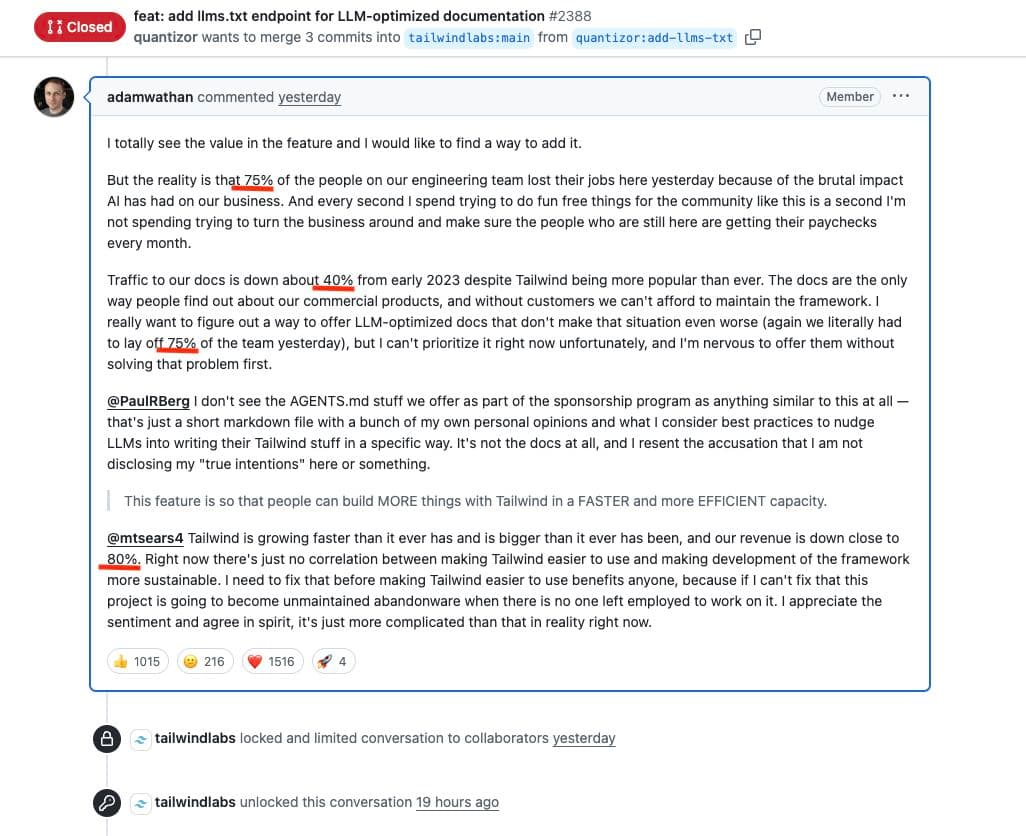
The numbers Wathan shared in a GitHub comment on January 7, 2026 paint a grim picture:
• Documentation traffic down 40% from early 2023 — despite Tailwind being more popular than ever
• Revenue down nearly 80% while the framework itself is "growing faster than it ever has"
• 75% of engineering team laid off to keep the company afloat
This is perhaps the clearest example yet of how AI is disrupting traditional open-source business models, particularly those built around documentation and educational content.
Why Documentation Traffic Matters
Tailwind Labs' business model, like many open-source companies, relies on a simple funnel: developers visit the docs → discover commercial products (like Tailwind UI) → purchase licenses. The documentation site isn't just educational — it's the primary marketing channel.
As Wathan explained:
<> "The docs are the only way people find out about our commercial products, and without customers we can't afford to maintain the framework."/>
When developers stop visiting docs and instead ask ChatGPT, Claude, or Copilot how to use flex justify-center, they never see the banner for Tailwind UI. They never discover Heroicons. They never learn about Refactoring UI. The entire commercial ecosystem becomes invisible.
The llms.txt Irony
The comment came in response to a pull request suggesting Tailwind add an llms.txt file — a proposed standard for making website content more accessible to LLMs. The irony was not lost on anyone.
Wathan's position was brutally pragmatic: while he eventually wants to add LLM-optimized documentation, doing so now would be "make that situation even worse". His priority is ensuring "the people who are still here are getting their paychecks every month."
A Warning for the Entire Industry
TailwindCSS isn't just any open-source project — it's arguably the most successful CSS framework of the past decade. According to the State of CSS 2024 survey, Tailwind has the highest satisfaction rating among CSS frameworks. It powers millions of websites. It has become the default choice for startups and enterprises alike.
If even TailwindCSS can't make documentation-based monetization work in the AI era, what does that mean for smaller projects? What does it mean for the entire ecosystem of developer tools that rely on documentation traffic to sell premium features, support contracts, or educational content?
The Uncomfortable Truth
Every developer who asks an AI assistant "how do I center a div with Tailwind" instead of visiting tailwindcss.com is contributing to this problem — often unknowingly. The AI was trained on Tailwind's documentation. The AI gives accurate answers. The user gets help faster. Everyone wins, except the people who created and maintain the knowledge in the first place.
This is the extraction economy at work: LLMs vacuum up human-created knowledge, repackage it without attribution, and deliver it in a way that completely bypasses the original source. The value flows to AI companies while the knowledge creators are left wondering how to pay their teams.
What Comes Next?
Wathan hasn't given up. He's looking for solutions that would let Tailwind Labs add LLM-friendly documentation while maintaining business viability. But the path forward is unclear.
Some possibilities being discussed in the community:
• API-based pricing where AI companies pay for access to high-quality documentation
• Embedded sponsorship in LLM responses ("Tailwind UI has 500+ components for this pattern")
• Gated premium documentation that provides value beyond what AI can access
• Community funding models like Open Collective or GitHub Sponsors at enterprise scale
None of these are proven at Tailwind's scale. All of them require significant changes to how the industry thinks about compensating open-source maintainers.
The Bottom Line
TailwindCSS v4 is still coming. The framework isn't going anywhere. But the company behind it is now a skeleton crew, and the broader message is clear: the old ways of sustaining open-source projects are breaking down faster than anyone expected.
For developers, it's worth remembering: every time you ask an AI instead of visiting the docs, you're making a choice about the future of the tools you depend on. That's not to say you shouldn't use AI — it's genuinely useful. But perhaps, occasionally, clicking through to the source wouldn't hurt.