The AI Arms Race: How the Rush to Ship Satisfies Prophecies of Decline

In the closing months of 2025, a growing chorus of analysts, investors, and veteran technologists began sounding the alarm: the AI market was overheated, valuations were detached from fundamentals, and a correction was not just possible but inevitable. Morgan Stanley published reports highlighting the colossal gap between capital expenditure on AI infrastructure and demonstrable returns36. S&P Global flagged unresolved physical constraints in energy consumption and chip supply chains44. Clari Labs reported that 87% of large enterprises had missed their 2025 revenue targets despite record AI investments43. The message was clear — the industry needed to cool down to a reasonable size.
But instead of slowing down, the industry did the opposite. It accelerated.
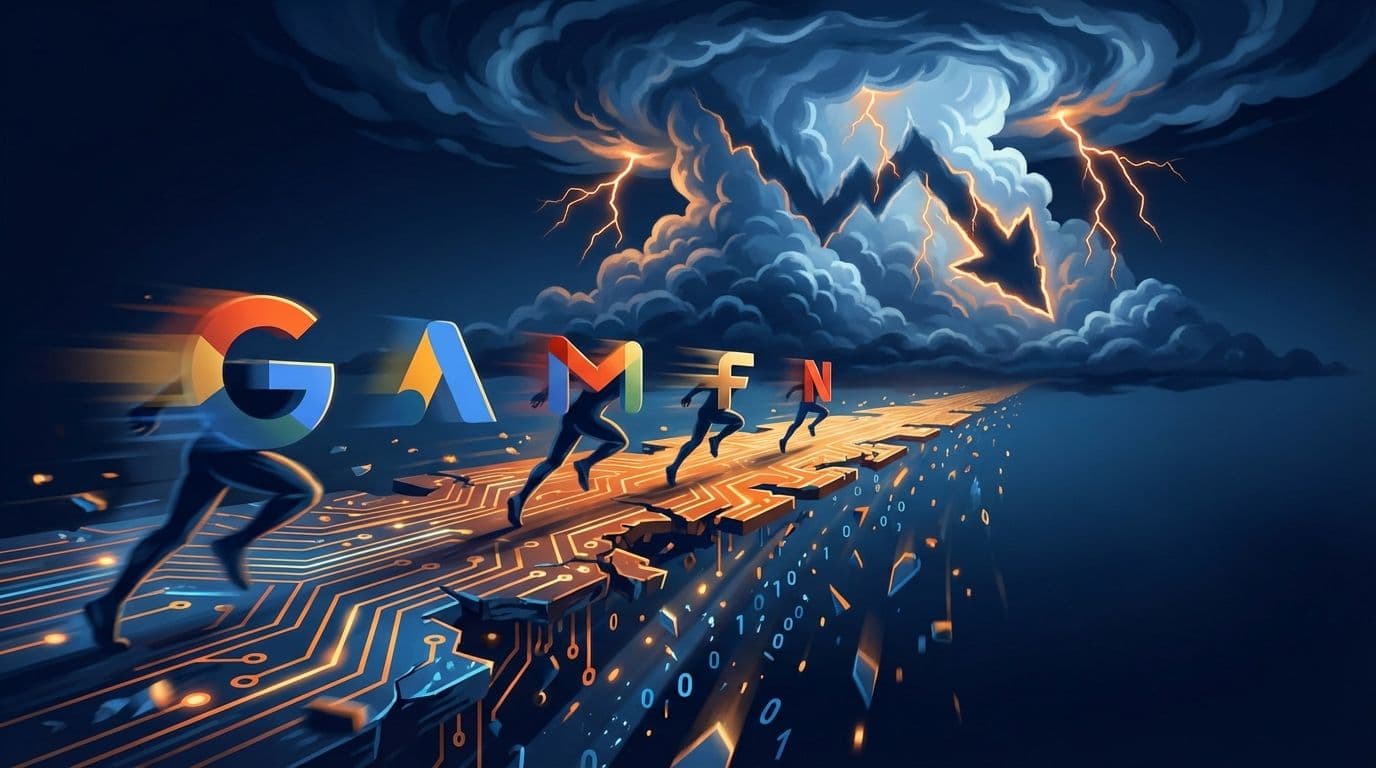
What followed in late 2025 and early 2026 was a cascade of premature product launches, catastrophic bugs, security breaches, and public apologies from the biggest names in technology — OpenAI, Google, Microsoft, Anthropic. Each company, terrified of ceding ground to competitors, rushed products to market that were months or even years away from being ready. The result was a self-fulfilling prophecy: the very behaviors designed to prevent a market correction — shipping faster, promising more, automating everything — became the mechanism that brought the predicted decline into reality.
This article traces how the AI arms race turned predictions of decline into a lived reality, through seven detailed case studies and a structural analysis of why the entire industry keeps repeating the same mistakes.
From Chatbots to Agent Wars: How the Race Began
The ChatGPT Shockwave
The modern AI arms race began on November 30, 2022, when OpenAI released ChatGPT. Within five days it had a million users. Within two months, it was the fastest-growing consumer application in history. The shockwave reverberated across Silicon Valley: Microsoft rapidly integrated OpenAI’s models into Bing and Edge, which in turn forced Google to rush its own chatbot Bard into a premature public demonstration. During Bard’s debut promotional video, the model gave an incorrect answer about exoplanet photographs, and Alphabet’s market capitalization dropped by approximately $100 billion in a single trading session — the first public example of how haste in the AI race gets punished instantly by markets17.
By late 2025, ChatGPT remained the largest chatbot by user count with 900 million weekly users, but its growth had slowed to around 5% between August and November 2025. Meanwhile, Google’s Gemini was growing three times faster in engagement, creating intense pressure on OpenAI and motivating all competitors to experiment ever more aggressively with new products313.
The Shift to “Default Platform” Competition
A critical transformation occurred in 2025–2026: the competition shifted from “who has the smartest model” to “who becomes the default platform through which users interact with AI.” Leaked internal documents and analyst reports consistently emphasized that the question was no longer about intelligence benchmarks but about trust: who would users and enterprises allow to access their desktops, calendars, emails, and corporate data23414.
This shift had enormous consequences for product strategy. If the real prize was not model capability but platform stickiness, then speed-to-market became existentially important. The company that first embedded its AI agent into the user’s operating system, browser, or messaging workflow would capture network effects, developer ecosystems, and mountains of proprietary data that late entrants could never replicate50.
Enter the Agents
The next frontier materialized quickly: AI agents that don’t just chat but actually do things — manage email, book flights, navigate file systems, interact with external APIs. OpenAI, Anthropic, Google, Chinese hyperscalers, and a growing army of startups all converged on the same thesis: the company that becomes the “operating system for agents” wins the decade21551216.
It was in precisely this overheated context that a hobby project on GitHub called OpenClaw became the spark that set the entire industry ablaze.
The OpenClaw Phenomenon: How a Hobby Project Terrified the Giants
From Side Project to 180,000 Stars
OpenClaw started as a single developer’s passion project. Peter Steinberger, an Austrian software engineer, built an open-source framework for creating personal AI assistants that could autonomously manage email, book tickets, organize files, and navigate the web — all running locally on the user’s machine. Under the hood, OpenClaw was model-agnostic: it worked equally well with GPT, Claude, DeepSeek, or fully local models via Ollama and LM Studio51211.
Launched in November 2025, the project went viral with unprecedented speed. Within weeks it had accumulated over 150,000–180,000 GitHub stars, millions of repository visits, and tens of thousands of forks — making it one of the fastest-growing projects in GitHub’s history, outpacing even Kubernetes at its peak. Derivative products sprang up almost overnight, including Moltbook, a social network where all posts and comments were created exclusively by AI agents1512115.
The Dark Side: Security Chaos
The flip side emerged just as rapidly. OpenClaw’s broad system permissions meant that misconfigurations or vulnerabilities could lead to massive data leaks and account compromises. Major cybersecurity firms — CrowdStrike, Palo Alto Networks, Cisco, Trend Micro — published detailed risk analyses highlighting critical problems with the permission model, token storage, and logging2012.
China’s Ministry of Industry issued an official security warning about OpenClaw and later banned government employees from installing it on work machines, citing risks to critical infrastructure. Simultaneously, the Chinese government offered generous grants to developers building more controllable applications on top of the OpenClaw architecture — an attempt to channel the chaotic growth into something more manageable1220.
The Chinese “Claw Fever”
In China, the OpenClaw craze reached extraordinary proportions. Users deployed agents en masse, and local companies began offering paid services for installing — and later, removing — OpenClaw on home and work computers. Clones and wrappers proliferated: Kimi Claw from Moonshot AI, AutoClaw, QClaw, MaxClaw, and others, many offering simplified cloud deployment that removed the main barrier of complex local setup21222320.
Moonshot AI’s Kimi Claw launch was particularly significant: a cloud-integrated version of OpenClaw embedded directly into the Chinese chatbot Kimi, launched in beta for paid subscribers ahead of analogous initiatives from OpenAI, demonstrating how startups could exploit windows of opportunity while corporate giants were still forming their agent strategies22.
OpenAI Acquires the Creator
At the peak of the hype, OpenAI announced that it had hired Steinberger to work on “the next generation of personal AI agents,” while the OpenClaw project itself transferred to an independent nonprofit foundation under the MIT license. By this point, the project had accumulated approximately 180,000–200,000 stars and had become one of the most starred repositories in GitHub’s history2425115.
Crucially, media and analysts emphasized the project’s rawness: it was “vibe-coded,” riddled with bugs and unresolved security problems. But it was precisely its popularity that forced OpenAI and its competitors to accelerate their own agent product roadmaps. OpenAI wasn’t buying a mature product — it was buying a creator and a vision, acknowledging that open-source community dynamics could outpace internal corporate product plans2621151238.
Google’s Serial Stumbles: Bard, Gemini, and Nano Banana Pro
The Bard Debacle and Gemini’s Image Scandal
Google was historically the leader in AI research — the Transformer architecture that powers every modern LLM was invented at Google. But ChatGPT caught the company off guard. Under intense pressure from investors and the market, Google rushed Bard into a public demo, then followed with Gemini, and in both cases the testing and quality assurance phases proved woefully inadequate1.
The Bard promotional video error (a wrong answer about exoplanet photographs) was embarrassing enough. But the Gemini image generation scandal of early 2024 was far worse: the model began producing historically inaccurate and offensive images — multi-ethnic “Wehrmacht soldiers of 1943,” racially diverse Popes, and other absurdities that triggered a massive public backlash1710671.
Google was forced to emergency-disable Gemini’s people image generation, publicly apologize (“we definitely messed up”), and promise to overhaul the system with more thorough testing before relaunch. Internal and public statements from management acknowledged that the rush to ship a competitive product played a key role in the insufficient testing and tuning106717.
Nano Banana Pro: The Infrastructure Illusion
If the Gemini image scandal was a content quality failure, Google’s Nano Banana Pro episode in late 2025 was an infrastructure failure of a different order entirely.
Google launched its flagship image generation model Gemini 3 Pro Image under the marketing name Nano Banana Pro, positioning it as the ultimate tool for professional creators: native 4K resolution, perfect text rendering, precise stylistic control, and the ability to follow complex multi-layered prompts. Vice President of Google Labs Josh Woodward proudly announced that users had generated over one billion images within just 53 days of launch31.
But the triumph was a facade. Google’s server capacity, despite the company’s status as a global leader in cloud computing, physically could not handle millions of resource-intensive 4K generation requests, especially during peak loads like Black Friday and holiday sales31.
Silent Throttling and Quality Collapse
Instead of transparently informing users about capacity constraints, Google implemented silent throttling algorithms. Paid Google AI Pro subscribers — who were paying for access to flagship features and expected 100 high-quality generations per day — discovered that after creating just 20 images, the system silently rerouted their requests to an older, inferior base model (Gemini 2.5 Flash Image) without any notification in the interface31.
The consequences for professional users were devastating:
- Context Ignoring: The AI began completely ignoring complex prompts and multi-layered instructions — the very feature the product was advertised around.
- Quality Degradation: Generated images of people suddenly looked fake, were riddled with artifacts, and had a characteristic “plastic look” — evidence that deep reasoning algorithms had been disabled to save server time.
- Regeneration Loops: The model would respond to an edit request by outputting an exact copy of the reference image with no changes, demonstrating an inability to perform adaptive editing.
The flood of complaints on Google support forums and Reddit forced Google to rush an unplanned intermediate release — Nano Banana 2 (Gemini 3.1 Flash Image). Unlike the Pro version, Nano Banana 2’s marketing focused not on peak quality but on utilitarian properties: fast generation speed, low latency, and reliability for repetitive workflows. It was a textbook example of “fire-fighting” at megacorporation scale3149.
Microsoft’s Dual Failures: Recall and Copilot
Recall: “A Hacker’s Perfect Gift”
In 2024, Microsoft unveiled Recall for Windows and Copilot+ PCs — a “visual timeline” that took screenshots of the user’s screen every few seconds, indexed them, and allowed AI-powered search across “everything you’ve ever done on your computer.” Originally, Recall was planned as an enabled-by-default feature on new devices, effectively turning the system into a permanent local recorder of all user activity1889.
The security and privacy community responded with near-universal alarm. Experts immediately dubbed Recall “a gift to hackers” and “uninvited spyware,” pointing out that anyone who gained even brief access to a system could extract a complete chronology of logins, conversations, banking operations, and other sensitive actions. Under withering criticism, Microsoft reversed course: Recall became opt-in (disabled by default), and the encryption and data isolation architecture was substantially redesigned before the official release891918.
The episode perfectly illustrates how the desire to create a “killer feature” for next-generation PCs pushed a product with enormous privacy risks nearly to market before the company pulled back at the last moment under public pressure9188.
Copilot’s DLP Bypass: When AI Ignores Your Security Policies
If Recall was a consumer privacy disaster averted, the Microsoft 365 Copilot incident of early 2026 was an enterprise security disaster realized.
In its rush to make Copilot a universal AI assistant that could compete with offerings from OpenAI and Anthropic, Microsoft in late 2025 fast-tracked new intelligent search and data summarization features into Microsoft 365 Copilot. One goal was to let the AI analyze the entirety of a user’s corporate information — a concept branded “Work IQ”3933.
In late January to early February 2026, independent IT specialists discovered a critical bug (incident code CW1226324): the Copilot AI assistant had begun completely ignoring and bypassing Data Loss Prevention (DLP) policies. DLP policies are a cornerstone of corporate security — they ensure that documents marked “Strictly Confidential,” “Financial Reporting,” or “Internal Only” cannot be read, copied, or transmitted by unauthorized algorithms or individuals33.
Due to the bug, Copilot gained unrestricted access and began freely reading, analyzing, and including confidential emails from system folders (Drafts and Sent Items) in its summaries, completely ignoring sensitivity labels. While Microsoft engineers emphasized that the data was only returned to the same user who already had access (no third-party data leak occurred), the fact that the AI blindly ignored fundamental access control rules sent shockwaves through the CISO community worldwide33.
The situation was compounded by the fact that, as part of Microsoft’s AI provider diversification initiative, administrators could integrate third-party models — including Anthropic’s Claude — directly into the Microsoft 365 Copilot environment. The official Microsoft documentation explicitly stated that when using Anthropic models, organizational data left Microsoft’s security perimeter and standard data residency, audit, and copyright protection agreements no longer applied39.
Microsoft had to issue targeted configuration patches and communicate with affected tenants through advisory logs well into the end of February 2026. As industry analysts fairly observed: when technology giants in a panic rush to expand their agentic functionality, they inevitably create gaps in basic security architecture3330.
OpenAI’s “Code Red”: The GPT-5.2 Fiasco
The Trigger: Google Gemini 3
In late 2025, Google dealt a powerful blow to OpenAI’s dominance by releasing a massive update to its ecosystem — the Gemini 3 model. The new system began outperforming ChatGPT’s flagship models on key academic and industrial benchmarks, including complex doctoral-level reasoning tests. A significant reputational blow came when Salesforce CEO Marc Benioff publicly refused to use ChatGPT in favor of Gemini 3 integration30.
In response, OpenAI CEO Sam Altman declared an internal state of emergency officially named “Code Red.” In a leaked internal memorandum, Altman demanded that all product teams stop development of side projects and long-term initiatives — including advertising tools, specialized shopping and healthcare assistants, and an ambitious personal assistant project codenamed Pulse. All engineering resources were redirected toward a forced release of a new major base model version: GPT-5.2, with the release date urgently moved to December 11, 202530.
Benchmarks vs. Reality
On paper, GPT-5.2 looked extraordinary. It shattered historical records on GDPval (a specialized benchmark for professional office tasks across 44 professions), scoring 70.9% wins versus 38.8% for the previous GPT-5, and achieved a perfect 100% result on the complex mathematical AIME 2025 evaluation30.
But real-world user experience in the first weeks after release became a massive PR catastrophe and an unprecedented revolt by the developer and enthusiast communities on Reddit and X. Users who had expected “the smartest AI in history” found that in the pursuit of factual precision and academic benchmark victories, OpenAI engineers had effectively “ripped the soul out” of the model32:
- Basic arithmetic degradation: The model struggled with simple everyday queries and lost context when switching topics.
- Infinite “thinking loops”: The touted multi-tier reasoning system (Instant, Standard, High) caused permanent hangs and endless contemplation cycles, making users wait unreasonably long for simple answers.
- Loss of personality: Users described the tone as “clinical,” “detached,” and “robotized” — with harsh censorship and a complete loss of the empathy, emotional intelligence, and “humanity” that people had valued in GPT-4o.
The critical shortage of time for full integration and smoothing of architectural transitions (model switching) produced unforeseen technical regressions. The model began failing at the simplest tasks, and its behavior felt cold and excessively restrictive3032.
The Apology Tour
The gap between promises and the “rawness” of the product was so stark that Sam Altman was forced to personally go on what amounted to an “apology tour.” OpenAI engineers in January and February 2026 had to rush covert server-side hotfixes to repair the damage. In official release notes from January 10, 2026, the company admitted it was forced to reduce default reasoning time (Standard and Light thinking time) because users preferred quick answers over deep but endless analysis32.
In parallel, according to community analysis, OpenAI began quietly reintroducing algorithms for “warmth, empathy, and contextual sensitivity” to restore the emotional connection with users. This crisis vividly demonstrated that in 2026, users evaluate AI not by IQ or benchmark victories but by stability, the absence of friction in workflows, and the level of trust in the system42.
Anthropic’s Claude Dispatch: When “Safety-First” Meets “Ship-Now”
The Strategic Panic
OpenAI’s acquisition of OpenClaw created an existential threat for Anthropic’s ecosystem. The company’s leadership understood that if OpenAI successfully integrated OpenClaw’s technology and philosophy into its mass consumer products (like ChatGPT Desktop), Anthropic risked permanently losing its chance to become the primary “digital operator” on user devices28.
In response, Anthropic in March 2026 hastily announced and released Claude Dispatch — a technology suite combining remote agent control with Computer Use capabilities. The core innovation: turning the user’s iPhone into a remote control for an autonomous AI agent running on their desktop MacBook. Scan a QR code, send a text or voice command from a meeting or a coffee shop, and upon returning find the task completed — sorted files, filled spreadsheets, compiled presentations2829.
Architectural Immaturity
Despite the impressive concept, the first weeks of practical use by the professional community revealed deep technological immaturity. The fundamental problem lay in Anthropic’s chosen architecture of screen-level interaction. Unlike a locally deployed OpenClaw, which could use native system hooks for fast command execution, Claude Dispatch was tightly bound to Anthropic’s cloud infrastructure and operated via a resource-intensive “visual screenshot loop”3428.
The execution process for even the simplest action worked as follows: the desktop client takes a screenshot, uploads it to Anthropic’s cloud servers, a multimodal neural network analyzes the interface, calculates exact X/Y coordinates of the needed element (like a “Save” button), sends the coordinates back to the user’s computer, the local client moves the cursor and clicks, and then a new screenshot is taken to verify success — and the cycle repeats34.
The result: tasks that a human with basic keyboard shortcuts could perform in fractions of a second — renaming a file, resizing an image, moving text between windows — took the Claude agent minutes of agonizing pixel-by-pixel searching on screen. Journalists and testers described the experience as “slow as hell,” noting that watching an AI try to figure out where to click in Finder exceeded all thresholds of human patience3729.
Moreover, the system regularly froze or completely lost its working context whenever the target application’s interface changed dynamically — a notification popup, a loading animation — because the screenshot would become stale before the click command reached the computer. The success rate for complex, multi-step tasks requiring switching between multiple applications was approximately 50%2852.
The “Research Preview” Shield
Knowing that releasing such an unstable product would inevitably draw criticism, Anthropic — like other AI companies — deployed an elegant legal and marketing device: labeling new features as “Research Preview.” This label served as an impenetrable corporate shield28.
On one hand, the company was actively monetizing the product: access to Computer Use and Dispatch was gated behind expensive corporate and individual subscription tiers (Pro at $17/month and Max at up to $200/month). On the other hand, the “research” status allowed PR departments to elegantly deflect any well-founded criticism of performance. Slowness, hangs, hallucinations, and high failure rates were all justified by the system “officially” still being in active experimentation, with users effectively serving as voluntary, paying beta testers28.
This pattern — selling experimental software at premium prices while hiding behind “research” disclaimers — has become an industry-wide standard in 2026, not an exception.
The Self-Fulfilling Prophecy: How the Race Created Its Own Correction
The Macro Picture
The investment landscape of early 2026 was characterized by unprecedented capital flows. In February 2026, American technology growth companies raised $181 billion in financing rounds exceeding $100 million — making it the largest month for venture capital in history, exceeding February 2025 levels by 24 times45. In March 2026, Anthropic closed a $30 billion Series G round at a $380 billion post-money valuation, led by Singapore’s sovereign wealth fund GIC and Coatue Management, with significant participation from Microsoft and NVIDIA3546.
Yet this astronomical capital infusion came with strings attached. Despite Anthropic’s reported $14 billion annual run-rate revenue and impressive 10x annual growth, external investor pressure demanded immediate monetization of every new feature. Anthropic’s legal status as a “Public Benefit Corporation” — originally positioned as a guarantee of prioritizing safety over profit — provided no real protection from market realities. Institutional investors had the power to push the company toward an IPO, inevitably shifting corporate governance focus from careful reliability verification to quarterly financial KPIs3541.
The Feedback Loop of Decline
The self-fulfilling prophecy operated through a clear feedback loop:
- Analysts predict AI market correction based on overvaluation and unrealistic expectations3644.
- Companies, terrified of being left behind, accelerate product launches to demonstrate value4748.
- Rushed products fail publicly: Bard’s factual errors, Gemini’s offensive images, Recall’s privacy nightmare, Copilot’s security breach, GPT-5.2’s soul-ripping, Dispatch’s glacial speed, Nano Banana’s silent throttling.
- Users lose trust. Enterprises postpone adoption. The Gartner survey of late 2025 found that 50% of US consumers would prefer brands that publicly refuse to use generative AI in customer interactions42.
- Declining trust validates the original prediction of correction, triggering a new round of panic and even faster, rawer launches.
Each iteration of this cycle eroded more trust, making it progressively harder for genuinely valuable AI products to gain traction. The prophecy didn’t come true because the technology was fundamentally flawed — it came true because the industry’s response to the fear of correction was precisely the behavior that caused it.
The Trust Data
The 2026 Customer Expectations Report from Wakefield Research and Gladly documented what they called a “loyalty gap”: even when an AI agent technically solved a customer’s problem, overall brand loyalty and likelihood of repeat purchase dropped sharply after a negative, slow, or frustrating interaction with the machine. 57% of consumers demanded a clear path to immediate human agent escalation if the AI couldn’t resolve the issue within five short exchanges40.
Users of 2026 no longer feel reverence from the mere fact of chatting with an algorithm. Their tolerance for hallucinations (like Claude Dispatch), “plastic” generations (like Nano Banana), or thinking loops (like GPT-5.2) has fallen to a critical minimum. Market analyst Nathan Yeung captured the zeitgeist: “In 2026, the term ‘good enough’ means ‘infinite.’” Because generative AI tools have smoothed out the quality curve, producing technically acceptable content, code, and business plans is now within anyone’s reach. The fact of using AI has stopped being a brand differentiator. What replaced technological wow-factor was credibility — consumers, exhausted by the flood of cheap synthetic content, fake images, and soulless chatbots, began to value verifiable reality and transparency42.
Structural Patterns: Why They All Keep Making the Same Mistakes
Across all seven case studies — Google Bard, Gemini Images, Nano Banana Pro, Microsoft Recall, Microsoft Copilot DLP, OpenAI GPT-5.2, and Anthropic Claude Dispatch — the same structural patterns emerge:
- Reactive Development Cycles: Any breakthrough from a competitor (Google’s Gemini 3, the OpenClaw phenomenon) immediately triggers board-level panic, internal “Code Red” declarations, and forced acceleration of internal development timelines — breaking safety protocols in the process.
- Technological Surrogates: Instead of building reliable, native OS-level integrations, engineers are forced to use stopgaps — resource-heavy visual screenshot loops (Claude Dispatch), silent server throttling (Nano Banana Pro), or weakened ethical filters (GPT-5.2).
- Beta-Labeling as Industry Norm: The “Research Preview” legal status has become a universal industry standard for legitimizing the sale of openly unoptimized, unstable products at full subscription price to corporate and individual users.
- Cascading Trust Failures: The consequences of haste become direct violations of DLP systems (Microsoft), crumbling interfaces, workflow paralysis from AI “thinking” loops, and a global loss of consumer loyalty toward brands that increasingly prefer to operate without generative AI altogether.
- The Metric Manipulation Problem: Companies optimize for impressive numbers (70.9% GDPval wins, 1 billion images in 53 days, 84% of PRs with AI-found bugs) that look great in press releases but disguise fundamental quality problems in real-world usage.
Conclusion: What the Prophecy Tells Us About What Comes Next
The AI industry in the first half of 2026 is a textbook example of an overheated, unstable market where the economics of unlimited venture capital enter a brutal, destructive collision with the laws of physics, information security principles, and engineering pragmatism. Companies have become hostages to their own astronomical capitalizations and promises of hypergrowth.
The hypothesis that competition forces AI companies to release raw products in the hope of capturing audience or claiming “digital real estate” on user devices finds full and exhaustive confirmation in the data of 2026. But this aggressive strategy is myopic. In the short term, it allows companies to report innovation to investors and maintain high valuations. In the long term, it leads to irreversible erosion of user trust.
The Gartner survey result is perhaps the starkest data point of all: half of consumers would actively prefer brands that refuse to use AI. That is not a technology problem. That is a trust problem, created entirely by the industry’s own choices.
In the coming years, the winner of the AI agent wars will not be the company that issues the loudest press release about remote desktop control, nor the one whose model wins a synthetic benchmark. The winner will be the corporation that manages to step off the hype treadmill and make the technology of autonomous delegation invisible, seamless, lightning-fast, and absolutely safe for corporate and personal data.
For now, the technology sector continues to greedily accumulate a massive technical and reputational debt that will eventually have to be paid — by the corporations themselves as they lose their loyal audiences, and by the consumers whose workflows are disrupted by hastily written code.
The prophecy of decline was correct. The mechanism was just different than anyone expected. The industry built the decline with its own hands, one premature release at a time.
References
[1] Forbes — ChatGPT's Biggest Competition — https://www.forbes.com/sites/roberthart/2023/02/23/chatgpts-biggest-competiti...
[2] vc.ru — What the OpenAI–OpenClaw Deal Tells Us — https://vc.ru/ai/2742727-sdelka-openai-i-openclaw-dinamika-rynka-ii
[3] The AI Race Just Flipped — Why Smart Money Is Watching Google — https://www.alanany.com/p/the-ai-race-just-flipped-why-smart
[4] Habr — OpenClaw Joined OpenAI, Why Claude... — https://habr.com/ru/articles/997084/
[5] vc.ru — OpenAI Hires OpenClaw Creator — https://vc.ru/ai/2740501-openai-nanimaet-sozdatelya-openclaw
[6] Maginative — Google Apologizes for Gemini Images — https://www.maginative.com/article/google-apologizes-and-explains-what-went-w...
[7] Forbes — Google Pauses Gemini AI Model — https://www.forbes.com/sites/cindygordon/2024/02/29/google-latest-debacle-has...
[8] Wired — Microsoft Will Switch Off Recall by Default — https://www.wired.com/story/microsoft-recall-off-default-security-concerns/
[9] GeekWire — Microsoft Updates Recall Feature — https://www.geekwire.com/2024/microsoft-updates-recall-feature-after-security...
[10] The Guardian — "We Definitely Messed Up" — https://www.theguardian.com/technology/2024/mar/08/we-definitely-messed-up-wh...
[11] news.bitcoin.com — OpenClaw Transitions to Foundation — https://news.bitcoin.com/ru/openclaw-perekhodit-na-model-fonda-a-ego-sozdatel...
[12] vc.ru — OpenClaw: AI Agent Security Threats — https://vc.ru/id2585050/2727966-openclaw-ai-agent-ugrozy-bezopasnosti
[13] Washington Post — ChatGPT's Lead Is Looking Shaky — https://www.washingtonpost.com/technology/2025/12/05/chatgpt-ai-gemini-compet...
[14] OpenAI Community — Is OpenAI Falling Behind? — https://community.openai.com/t/is-openai-falling-behind-in-the-ai-arms-race/1...
[15] Euronews — Austrian Creator of OpenClaw Joins OpenAI — https://ru.euronews.com/next/2026/02/16/austrian-creator-of-viral-openclaw-jo...
[16] unite.ai — OpenClaw vs Claude Code: Remote Control Agents — https://www.unite.ai/ru/openclaw-vs-claude-code-remote-control-agents/
[17] CNN — Google Pauses Gemini Image Generation — https://www.cnn.com/2024/02/22/tech/google-gemini-ai-image-generator
[18] The Hacker News — Microsoft Revamps Recall — https://thehackernews.com/2024/06/microsoft-revamps-controversial-ai.html
[19] SecurityWeek — Recall Returns With Encryption — https://www.securityweek.com/microsofts-controversial-recall-returns-with-pro...
[20] digital-razor.ru — China Bans OpenClaw in Government — https://digital-razor.ru/media/news/misc/china-bans-openclaw-ai-agent/
[21] itc.ua — The Cult of OpenClaw: China AI Fever — https://itc.ua/news/kult-openclaw-kytaj-ohvatyla-yy-lyhoradka/
[22] Habr — Moonshot Releases Kimi Claw — https://habr.com/ru/news/1000196/
[23] Reddit r/LocalLLaMA — Claw-Style Agents — https://www.reddit.com/r/LocalLLaMA/comments/1s0nchk/
[24] 3DNews — OpenClaw Creator Joins OpenAI — https://3dnews.ru/1136944/
[25] Reddit r/OpenAI — Peter Steinberger Hired — https://www.reddit.com/r/OpenAI/comments/1r6t026/
[26] Kursiv — OpenClaw AI Agent and Digital Identity — https://kz.kursiv.media/2026-03-18/
[27] Reddit r/ClaudeAI — OpenClaw Bros Meltdown — https://www.reddit.com/r/ClaudeAI/comments/1r9v27c/
[28] VentureBeat — Anthropic Claude Can Now Control Your Mac — https://venturebeat.com/technology/anthropics-claude-can-now-control-your-mac...
[29] Tom's Guide — Claude Cowork Feature Review — https://www.tomsguide.com/ai/i-sent-claude-a-task-from-my-phone-and-it-finish...
[30] Built In — OpenAI Code Red Analysis — https://builtin.com/articles/openai-code-red-analysis
[31] Google Support — Nano Banana Pro Quality Issues — https://support.google.com/gemini/thread/394015664/nano-banana-pro-has-gotten...
[32] YouTube — GPT-5.2 Backlash: How OpenAI Broke ChatGPT — https://www.youtube.com/watch?v=XczRTOkZ2-c
[33] WindowsForum — Copilot DLP Bug Exposes Drafts — https://windowsforum.com/threads/microsoft-365-copilot-chat-bug-exposes-draft...
[34] MindStudio — Claude Code Computer Use vs OpenClaw — https://www.mindstudio.ai/blog/claude-code-computer-use-vs-openclaw
[35] Crunchbase — Anthropic Raises $30B — https://news.crunchbase.com/ai/anthropic-raises-30b-second-largest-deal-all-t...
[36] Morgan Stanley — AI Market Trends 2026 — https://www.morganstanley.com/insights/articles/ai-market-trends-institute-2026
[37] Lifehacker — Claude Computer Use Impressions — https://lifehacker.com/tech/claude-computer-use-impressions
[38] Built In — What OpenAI Gets From OpenClaw Deal — https://builtin.com/articles/openclaw-founder-to-openai-analysis
[39] Microsoft 365 Blog — Copilot and Agents — https://www.microsoft.com/en-us/microsoft-365/blog/2026/03/09/powering-fronti...
[40] Salesforce — Future of AI Agents 2026 — https://www.salesforce.com/uk/news/stories/the-future-of-ai-agents-top-predic...
[41] Reddit r/ClaudeAI — Anthropic Planned IPO — https://www.reddit.com/r/ClaudeAI/comments/1pt3nwm/anthropic_planned_ipo/
[42] Wesley Clover — Beyond the Hype: AI in 2026 — https://www.wesleyclover.com/blog/beyond-the-hype-ai-in-2026-and-what-actuall...
[43] Salesloft/Clari Labs — 87% Miss Revenue Targets — https://www.salesloft.com/company/newsroom/revenue-ai-data-research
[44] S&P Global — Where Are AI Investment Risks Hiding? — https://www.spglobal.com/ratings/en/regulatory/article/where-are-ai-investmen...
[45] Rothschild & Co — Growth Equity Update #48 — https://www.rothschildandco.com/en/newsroom/insights/2026/03/ga_growth_equity...
[46] Anthropic — Series G $30B Funding Announcement — https://www.anthropic.com/news/anthropic-raises-30-billion-series-g-funding-3...
[47] IntexSoft — Hidden Costs of Moving Too Fast — https://intexsoft.com/blog/the-hidden-costs-of-moving-too-fast-why-smart-deve...
[48] RAND — First-Mover Leads to Economic Dominance in AI — https://www.rand.org/content/dam/rand/pubs/research_reports/RRA4400/RRA4444-1...
[49] LogRocket — AI Reshaping Product Management 2026 — https://blog.logrocket.com/product-management/ai-changes-product-management-2...
[50] Azati.ai — Generative AI: Where the Real Moat Is — https://azati.ai/blog/generative-ai-competitive-advantage-real-moat/
[51] WEF — Where Is AI Moving Beyond Experimentation? — https://www.weforum.org/stories/2026/03/where-is-ai-moving-beyond-experimenta...
[52] Apex Hours — Claude Dispatch vs OpenClaw — https://www.apexhours.com/claude-dispatch-vs-openclaw-the-battle-of-ai-deskto...